• How we do image enclosures

    After using the Artcasting feature in FeedLand, I have mixed feelings about how it works because of the way some sites use the feature.

    Sometimes it’s not hugely bad, just mindless, like a feed that attaches a picture of a bunch of basketballs on every story about basketball. I don’t want that in my river.

    The images really interfere with skimming.

    Or the NYT puts some good pictures on some, and really tiny impossible to see pictures on others. I’m going to turn off the NYT images because their enclosures are very far from spec. No length attribute and the type is “image” — which is not a type, it would have to be “image/png” or “image/gif”.

    Also, it’s not consistent with the way FeedLand shows podcasts, as a little headphone in the icon array at the bottom of the item, enabled if there is an audio or video enclosure. It’s so hard to see I’ve gotten feature requests asking that FeedLand supports podcasting. 😉

    So I’m not sure we’ve reached the answer yet. Wanted to get it down that I’m thinking about this.

  • What I’ve learned about WordPress

    Thinking about WordPress this morning, APIs and feeds…

    This last year I’ve gotten caught up with WordPress, have been asking questions, and one of the best thing about this setup is that the doors have been open. I have great teachers who are encouraging me, and of course are experts in and proud of WordPress, and as a result I think FeedLand and WordPress are going to work together in some very nice ways. Getting pretty close on some of it.

    A year ago I didn’t even know that WordPress still had APIs. At some point the code I had that worked with the MetaWeblog API and WordPress broke, and I assumed that it was the end of the line, and took the feature out of my linkblogging tool. But I was wrong. And not only that there was Calypso, a modern REST interface. It’s all there. I love it.

    Getting FeedLand to work in the new environment has been a step by step process. It was built to run on a Digital Ocean server, with a file system. I’ve converted now all the pieces we needed, and it seems finally to run smoothly.

    Onward! 😉

    PS: I cross-posted this to Scripting News.

  • Artcasting in FeedLand v0.0

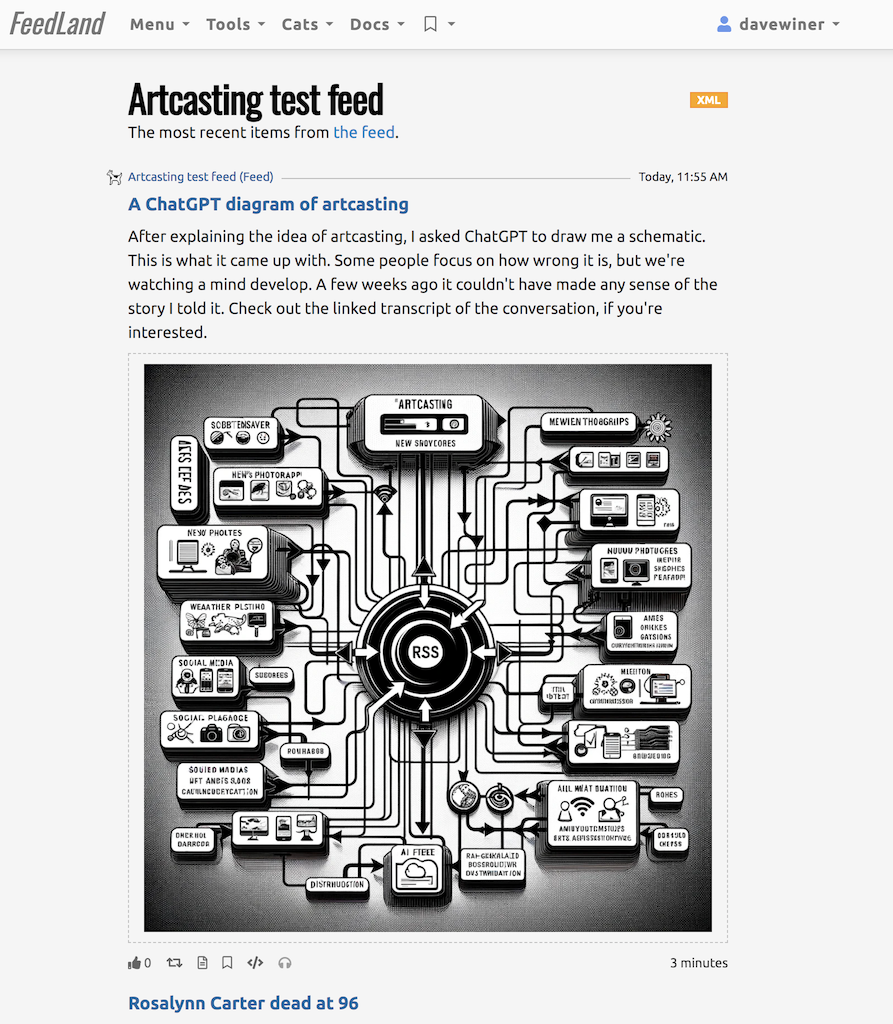
    New feature. When a feed item has an image enclosure, we include it, after the body of the item, but before the icons below the item.

    So far I’ve only tested it with the demo feed.

    Click this link to see for yourself.

    I took a screen shot because this is likely to change.

  • The magic of categories and reading lists

    A few days ago, Frank Meeuwsen posted, on his blog via micro.blog, a challenge to show him our blogrolls.  I found it via Chuck Grimmett. Frank is a longtime user of my various bits of software, and his blogroll is really good.

    His blogroll is of course sourced in OPML. It became the standard for blogrolls a long time ago, and apparently is supported by WordPress. You can give it an OPML file and it will display it in HTML on your WordPress site.

    At some point we’re going to ask Frank and others to use the OPML category attribute to put each feed in their OPML file in the bloggers category (and any others they feel apply, comma-separated).

    Here’s an example, one of the FeedCorps feeds, to show how categories are used.

    I’m going to subscribe to Frank’s OPML file in FeedLand, as Chuck already has. 🙂

    Now it gets interesting.

    Suppose Chuck also publishes his blogroll the same way, with each feed in the OPML file assigned the bloggers category. And suppose a few other people do as well.

    Suppose I subscribe to all three of these OPML files, then if you look at the bloggers category for my FeedLand, you’ll get a combination of all three lists, and whatever feeds I’ve subscribed to individually and assigned the bloggers category.

    And because reading lists are periodically re-read and the subscriptions are all kept in sync, my reading list will represent the state of all the reading lists I’ve subscribed to.

    Thanks to the combination of categories and reading lists.

  • Artshow2

    new version of the Artshow app that builds on Bluesky RSS 2.0 feeds.

    It’s also a FeedLand app, and a news reader that doesn’t look like a typical news reader,

    Proof of concept that there’s more to feed “reading” than we might think (podcasting is a form of feed reading that doesn’t look like a feed reader either).

    We need another project category for apps that prime the pump for more apps of that type.

    The source code is available.

    PS: A Scripting News post on this topic.

  • Going for 1.0, shipping

    I’m going through the Project list and deciding which things have to be done before “shipping” and which can happen after we ship.

    I don’t want to rush to have to write docs when we have a user who is asking for a complicated and yet-undocumented feature. This happened the other day with Reading Lists. There are almost no docs for that. So docs review and new docs goes before shipping.

    Imagine a line, on one side of the line are things that must be done, and on the other side things that can wait and be part of the normal shipping of features to an active user base.

    Things that can wait till after shipping

    • rssCloud for reading lists

    • WordPress integration

    • Overriding titles

    • News products tools

    Things that can’t wait

    • Docs review

    • Starter feeds

    • WordPress signup

    News product tools can wait

    For now think of News Products as something we use the way the concierge people at A8C use their tools to create unique experiences for people and orgs we work with. We’ll use that process to get a really good, polished set of development tools to share with users. But let’s give it a bit of time to mature.

    WordPress integration — depends

    It might be very little work.

    I’m going to share a browser-based JS page that displays a river from feedland.com. Nothing else.

    Can we get this code to run in a WordPress page?

    How easy that is to do will determine whether it’s pre or post-shipping.

    Plan

    We’ll have this list fleshed out by the Thursday meeting (Nov 16).

  • Example of a FeedLand API

    I just added a new REST call for the FeedLand server — getriverfromreadinglist.

    It takes one parameter, the URL of a reading list.

    It must be one of the reading lists the server knows about, someone must have already subscribed to it.

    It returns a river structure with items from the feeds in the list, reverse chronologic and grouped by feed.

    I’m really excited about this call. We already have lots of getriverfrom APIs. But reading lists are fantastic packages, we see them coming up as unifying and simplifying structures.

    Specifically I am going to do the new Art Show app using this call. It’s exactly the information the app needs from FeedLand.

    Here’s an example of the call it’s likely to make.

    https://feedland.org/getriverfromreadinglist?url=https://lists.feedcorps.org/artshow.opml

    Note that at this instant the software is only installed on feedland.org.

  • Big picture of FeedLand

    FeedLand is where feeds, news and people mingle.

    Where it’s easy to find a feed from another user and add it to your list of feeds.

    And categorize each feed so it shows up in the places you want inside or outside of your FeedLand.

    It also allows you to share lists of feeds with users of other systems that work with feeds.

    And it goes the other way too, we import feeds, and lists of feeds which you can subscribe to.

    Or you can create lists of feeds other people can subscribe to.

    We want to build another layer on the feed ecosystem.

    What will come from that? No one knows. We want to find out! 🙂

    We, along with you, want to use FeedLand to build networks of feeds, news and people.

  • Introducing FeedLand to DotOrg and Other Bets in Málaga

    I gave a flash talk about FeedLand at the 51 / DotOrg / Other Bets Division Meetup in Málaga, Spain. Here is a snapshot someone took of me with the slide explaining who Dave is for those who didn’t know.

    In the short talk I planted the seed of reading lists for Pocket Casts and news products for all of the teams in attendance.

  • Hacking the CSS of FeedLand

    1. Create a stylesheet, put it somewhere where it’s publicly accessible.

    2. In the JavaScript console assign the URL of the stylesheet to localStorage.urlStartupStylesheet.

    3. Reload FeedLand.

    Example

    Enter this in the JavaScript console where FeedLand is running.

    localStorage.urlStartupStylesheet = ‘urlofmystylesheet’